
“Our mind has unlimited power; it can be your greatest friend; if not, it becomes your worst enemy.”
The mind is humanity’s most lively tool—subtle yet powerful, invisible yet affecting every aspect of everything. It forms our thoughts, emotions, and actions physically, psychologically, and spiritually. Scientifically, the mind governs the body’s systems by brain activity, transferring sensory information to memory, and interpreting it. However, above the psychological function of the brain is its extraordinary spiritual power to envision, create, concentrate, and transcend the body and mind, where intentional, conscious thoughts shape our emotional desires, check and guide us toward higher consciousness, or lead us to suffer in lower consciousness.
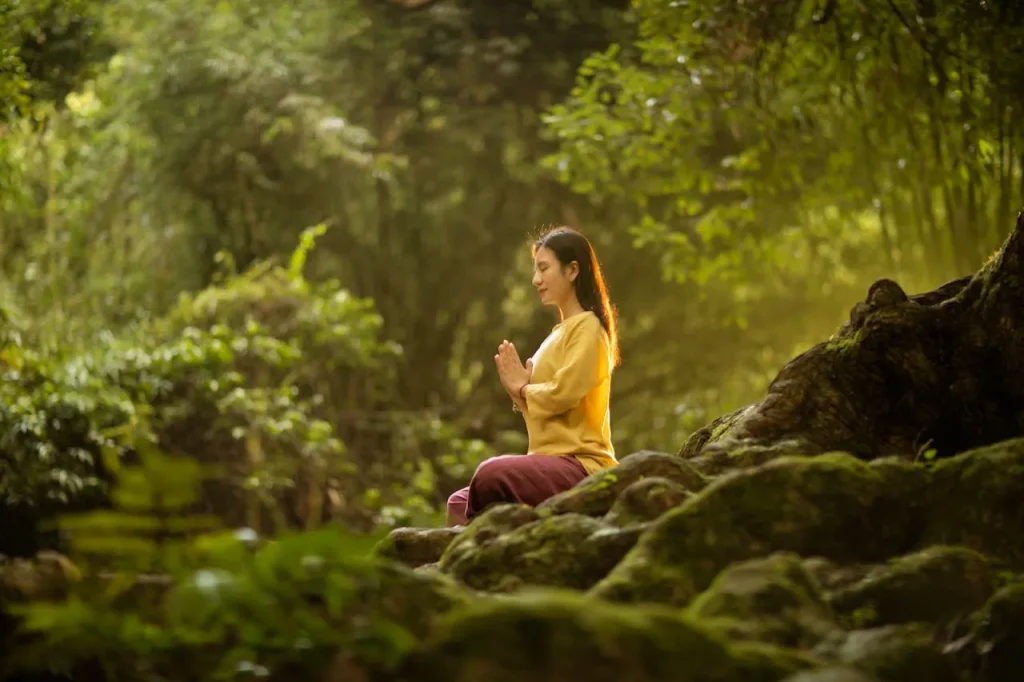
But the greatest strength of the mind is beyond its inception. Spiritually, we move beyond cognition as a source of self-discovery and self-knowledge to experience and recognise the genuine self rather than viewing it as a cognitive instrument. When still, it removes the illusion of separation and paves the way to inner silence with spiritual knowledge under meditative awareness.
Ancient sages transcended the mind not by relying on intellect but by spiritually quieting it to connect with the divine essence and experience that divineness in pure awareness. The mind’s ultimate power lies in its capacity to access and surrender to its source, the spirit that is immersed within the soul. The mind transforms from a mechanical machine to its actual being-ness in spiritual divinity as it bows to spiritual knowledge, transcending cognitive abilities into total awareness.
Human minds are their most potent instrument in the universe; the most profound ability of the mind is to cohere with the universe and concurrently adjust with the outer world. The mind helps us connect our inner experiences with outer reality, directing our responses to the chances and challenges of life. It can utilise its infinite intelligence through the spirit of awareness settled in the superconscious section of the mind, which we refer to as the soul, transcending physical and cognitive limitations.
The mind works through ideas and beliefs, both consciously and unconsciously. Our belief system’s constant development helps us guide our conduct and ultimately shape our lives, enabling us to achieve remarkable accomplishments. In contrast, a disorganised or negative mind can cause difficulties and suffering. Using the mind correctly requires spiritual practice, the primary being constantly witnessing your thoughts to keep them in check, with meditative awareness, moment to moment, while being constantly alert and attentive, which in turn makes the mind aware and conscious.
If spiritually tuned, the mind can transcend duality and ego to experience higher degrees of consciousness. Great thinkers and sages from the past have stressed that control of the mind leads to control of life.
The mind, then, is a tool as much as a battleground. When regulated and intentional, it can enhance the quality of life and reveal limitless possibilities. Accurate power results from inner mastery of thought, consciousness, and intention, much more than what we materially achieve in battling with outside circumstances.
Cosmic energy surrounding us can operate as an awareness-enhancing power of the mind by manifesting within it. This supreme ability of energy is non-dual and embodies absolute intelligence. Yet, it requires duality or opposites to help the superconscious section, the soul, become aware and conscious of its choices and experiences.
Awareness is the essence of ‘who we are,’ and our mental experiences—consciousness—define ‘what we are.’ The body finally reflects ‘how we are,’ revealing the radiance of our self-awareness. The spirit in the soul represents the absolute non-dual being-ness, defined as the witness in waves of aware energy. An awakened soul, in turn, plays the part of an individual witness-er to observe, check, and guide the excessively flowing mind engaged with dualities in the lower, or what we call the subconscious mind.
Through our consciousness, the human mind operates in a state of duality. It possesses the gift of choice, having the prerogative to choose between the divine and the devil to determine which direction we wish to take. The attribution here relates to the intensity of aware energy, which comes before everything, as the spirit symbolises our true self as ‘That art Thou.’
The mind becomes detrimental only when we permit it to control us through the emotional desires of our five senses, which in turn selfishly influence our identifications and attachments. In such a case, our self-consciousness, instead of being the master, becomes a victim of the ego-consciousness.
Therefore, the power of our mind determines the path it chooses—material, spiritual, or balanced—that we wish to follow based on the intensity of our inner aware energy represented by the suffix of -ness as awareness followed by self-consciousness through our external and internal perceptions.
The illusory play within the mind, which we can observe in the chattering of our selfish thoughts, is what the ancient sages called the Dance of Nataraja. The mental process in this journey of illusions begins with our basic instincts: intuition, intelligence, imagination, and intellect. Ultimately, our life’s intention should be to harness the mind’s spiritual power, aiming to overcome the objective physical self and engage with dualities, thereby transcending them toward a non-dual state of the mind.
When the mind thinks in duality, it restricts itself to the limited field of objectivity. However, when it observes non-judgementally and with alertness and attentiveness, the mind becomes aware and conscious existentially from one moment to the next. It enters and merges with the infinite, limitless field of potentiality in probability to actuality in the now. You enter the realm of spontaneous awareness in creativity and intuition rather than being in the past or future. The power of the spiritual mind is no less than the power of the universal divine, signifying that the individual’s true self is no less than or separate from the universal God in Sanskrit- Tat tvam Asi (That art Thou).
NAMASTE
Leave a Reply