
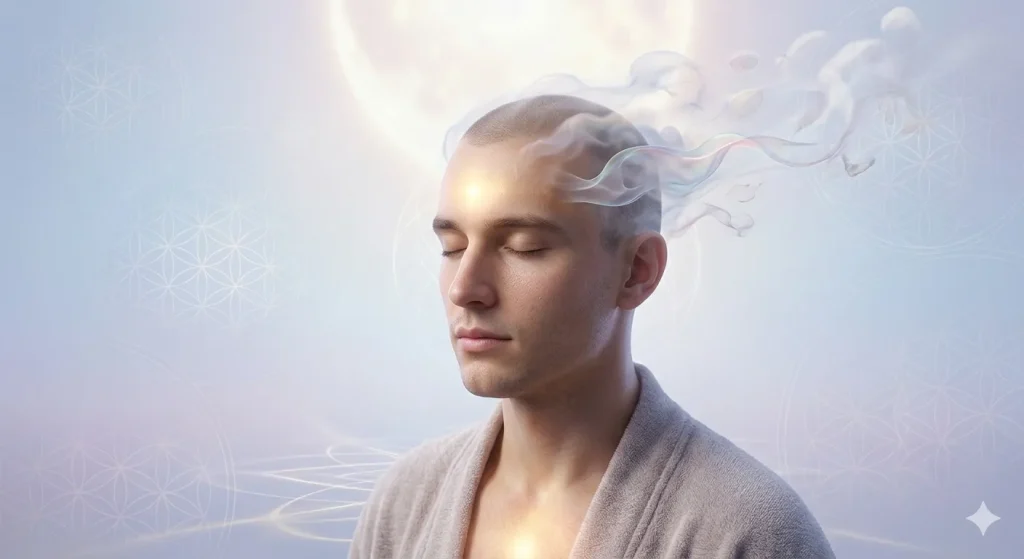
Thoughts are the intangible threads that weave the fabric of human experience. Philosophically, we see them as the essence of consciousness—the neural activity that defines our inner world. From ancient times, thinkers such as Descartes have emphasised thought as a means of proof of existence. In the Vedantic and Buddhist traditions, thoughts are considered illusions (Maya) that arise in the mind, obscuring the pure self, the soul, or consciousness. Thus, thoughts are not merely mental chatter but the manifestation of a deeper, metaphysical reality, shaping how we interpret and engage with existence.
Scientifically, thoughts are an electromagnetic flow of information produced by chemical activity in the brain through neural activity. Every thought arises from a complex network of neurons firing in specific patterns, influenced by both internal and external stimuli, as well as memories and emotions.
Where science focuses on the ‘how’ thoughts originate, philosophy seeks the ‘why’ thoughts exist. The two perspectives converge, where both theories of mind aim to bridge the gap between physical processes and subjective experiences concerning aware energy being the source of thoughts. Thoughts become a function of biological hardware and a window into metaphysical questions about identity, attachments, and consciousness. Whether seen as sparks in the neural network or weaving them through aware energy, making them conscious through the soul, encompassing both the conscious and subconscious sections. Thoughts remain the ever-active agents of our reality—constructing, interpreting, and often distorting the world we perceive according to personal comprehension.
In essence, thoughts are both real and illusory—real in their effects, impermanence, and subjectivity. They are the construct of our beliefs, emotions, and actions, yet countless unseen influences shape them. Philosophically, to understand thoughts is to question the nature of the self; scientifically, it is to trace the patterns of the mind. Together, these lenses remind us that while thoughts arise constantly, our freedom lies in becoming aware of them, not as truth, but as transient expressions of a purer consciousness.
Thoughts are an intangible flow of electromagnetic information produced by chemical activity in the brain, gliding through neural activity via neurons. The information originates from external stimuli that stimulate the sensory organs to perceive and transfer information for the mind to decipher and relate through thoughts. And internally, from self-observation, memory, and emotional feelings. They also occur spontaneously from the unconscious section, or spiritually, the superconscious section, which we call the soul—intuitively, instinctively, and telepathically.
All those mentioned above occur because of the presence of aware energy before the mind begins to think. Spiritually, the intensity of aware energy, pointed to by its suffix of -ness, is the presence of who you are. If awareness is not there, your thoughts are not there. You can read your thoughts and refer to them as your thoughts. Furthermore, you can briefly distract or direct your thoughts. So, how can you be your thoughts? You cannot. And you will never say that you are thoughts, nor will you ever say that you are the mind. Instead, you will always say, my mind and my thoughts, implying the mind is yours. Mind is an instrument for you to use and not to be used by your thoughts.
Spiritualism and science claim that everything in the universe is indivisible energy, which we cannot create or destroy, vibrating at different frequencies. Energy is not a thing but the ability, power, or capacity to do work. Thought is an example of psychic energy. According to the Second Law of Thermodynamics, energy tends to move towards entropy, or disorder, much like thoughts do. Our thoughts multitask, are repetitive, and uncontrollable. That is why the mind is uncontrollable. It is tough, if not impossible, to control one’s thoughts.
Spiritualism revolves around ‘who you are’ beyond your physical body and mental faculties. It means that we can come to know ourselves only when we quiet or silence our thoughts through meditative awareness. Until and unless we silence our thoughts, we do not come to know our authentic selves, nor can we awaken our real selves. Thoughts create a false self, tricking us into believing, ‘I am that.’ It is your personality, not your individuality. It is your persona. Like in Greek, the persona is that false mask ruling over you, your body, and your mind. It is ruling over you through its desires and emotions. It is that false self of me, mine and myself, for self-preservation.
Thoughts are often repetitive and can be negatively harmful. According to science, approximately 80% of our thoughts are negative. I would even say that thoughts aggravate most of your problems. It happens because the moment a crisis comes, thoughts create agitation, conflict, anxiety, and depression by thinking about that subject again and again. Thoughts are often the cause of many of your problems. They aggravate whatever is bothering you. They are of two types: spontaneous thoughts and thoughts that are chosen.
The human mind functions through voluntary thoughts, choosing between options for its self-interest. It functions in duality. It fundamentally chooses between likes and dislikes, good and bad, positive and negative, hot and cold, etc. So, the mind functions in dichotomy, in opposites. Choiceless thoughts are involuntary and non-dual. In non-dual spontaneous thinking, there are no choices. The mind does not need to separate the totality, the wholesomeness of the energy, into duality from its oneness. Non-dual thoughts occur spontaneously, unplanned, and on the spot, without any deliberate choices for this or that. It’s that eureka moment when you exclaim, ‘Bingo, I’ve got it.’
Our ancient sages have said in Advaita Vedanta, where ‘Advaita’ means ‘not two’ and ‘Vedanta’ means the end of knowledge. It means there is no such thing as two, and neither is there one; all that exists is transient within the nothingness of what we refer to as the universe. All that exists in the nothingness of the universe is Brahman (energy) in its absoluteness in totality, from which all subset energies appear to disappear, whether nuclear or psychic energy. All subsets or temporary energies are interchangeable, from wind to electrical energy, and superimpose on the substrate of the supreme non-dual energy.
Similarly, thoughts appear from the force of aware energy, creating a field of consciousness. They originate from the superconscious in purity, flowing towards the conscious and then further into lower or subconscious thoughts, gradually disappearing after settling within the memory to reappear, if required, later. All thoughts return to their nothingness or the absoluteness of the universe from which all sorts of subset energies, like chemical, nuclear, electrical, psychic, and magnetic energies, interchanging within themselves, disappear back into the absoluteness of dark energy, which comprises around 96% of the universe.
Therefore, amid all the transient abilities of absolute energy, our sages claim one supreme ability: aware, conscious energy. It has been well exemplified in the four Mahavakyas (great sayings) of the Vedas – That art Thou. That is who we are: aware, conscious energy—awareness first, consciousness second. The -ness suffix in awareness or consciousness clarifies the intensity of any individual energy.
Aware, conscious energy differentiates living from non-living. A rock will not be conscious, whereas for a living creature, the intensity may differ. The plants are aware and conscious, the animals are more conscious, and we humans have the highest intensity and potential of consciousness.
That is why the sages claimed you are divine and the devil, the creator, and its creation. That insight within the spirit, or aware energy, is the absolute aware energy that spontaneously flows through the soul. It settles in the soul – the superconscious section of the mind, emerging involuntarily when it is silent, to witness your mind and its dual-operating thoughts quietly. Without this aware energy, even the universe does not exist.
It means that when the mind is silent, the soul awakens. Or, when the mind is doing something incorrectly, there is a subtle warning from this aware energy. If you are overeating, a warning will be issued. If you are drinking alcohol, once you exceed a specific limit, it will tell you to stop before it dulls your mind. Anything you should not be doing, this aware energy guides you in its wholesomeness via the soul acting as a witness-er. The soul simply witnesses in non-duality with absolute awareness. Since we cannot control our minds, the soul checks and guides the mind.
The choiceless thoughts arise when the mind is alert and becomes aware spontaneously in the present moment. Choiceless awareness is always present in the moment, existing from one moment to the next. It is called meditative awareness or mindfulness. When the soul awakens, and the mind is silent, the divine within awakens.
Choiceless awareness may account for only about 0.5% of our thoughts. According to neuroscientists, over 98% of our mental functions operate at the subconscious level, drawing from past awareness rather than the present. So, the thoughts are now voluntary and can be chosen. It means that with every thought, you have an option granted to you that is not available to animals or plants.
You have the power of choice in the highest manner to choose from random thoughts. The mind mainly extracts past information from memory and a small portion of its intelligence from the present. So, over 98% of the thoughts are from the past. It extracts and sends this information through neural cells to the intellect, which reasons, evaluates, analyses, judges, and decides which option to choose between two factors.
The mind is subconsciously working in auto-mode, drawing on its past awareness, either mechanically or intellectually, which means operating in a lower consciousness, segregated into duality. The remaining small portion of choiceless thoughts functions intelligently from fresh awareness spontaneously, while creating every individual as unique. The soul plays a crucial role in providing such fresh awareness. It simply observes and witnesses. So, thoughts, by and large, appear and disappear, like all subset energies appear to disappear, back into the absolute non-dual ‘Shunya’ in the nothingness of this universe. All energy, whether physical or mental, ultimately returns to its source, which is absolute energy.
When the mind is alert, it becomes aware; if the mind is attentive, it becomes conscious. From the conscious level, it moves into the subconscious level. Consciousness goes to sleep when the mind is in a deep state of sleep. But the moment you wake up, you know everything around you; you no longer need to be conscious again. It means that awareness does not go to sleep. It is the conscious energy that goes to sleep. Awareness is the ultimate energy; that is why we have the ultimate potential to explore, discover, and invent everything in the universe, not plants and animals.
So, you are that aware energy through which you reflect and radiate knowing from the macrocosm to the microcosm. You are just waves of energy. That is why science claims that every atom is 99.999% space because all that exists is just waves of absolute energy.
The soul is asleep most of the time. All your past information is stored in your intellect, and memories are recollected from external sources, such as books, media, or the internet. You become an intellectual out of that, a scholar with a specific degree, and feel so proud, presuming that this is who you are. But you do not realise that what you understand through that information emerges from your intelligence, instinct, and intuition. This intelligence is your aware energy – the basis, quality, or the subject of ‘who you are.’ Meanwhile, thoughts operating in duality, collecting and choosing this or that, are the quantitative factor of ‘what you are.’
Therefore, the source, subject, and context of ‘who you are’ is aware energy. It is exclusively dealt with in the Vedas. In the first Mahavakya (one of the four great sayings from the Advaita school of Vedanta), Prajnanam Brahma, or “Intelligence is Divine,” it is stated that the creator and the creation are the same. They are not two. So, thoughts are a neural flow of electromagnetic energy emerging from chemical activity in the brain. They are the carriers of information here, and the source is not that; the source is who you are from the intensity of aware energy in awareness.
NAMASTE
Leave a Reply