

In Advaita Vedanta and many other Indian philosophical traditions, Brahman is the ultimate, formless, infinite, all-pervading absolute reality. It is the substratum of all existence beyond time, space, cause, and dualism. The essence is that Brahman is not a god but pure, unchanging, aware-intelligent energy (Chaitanya). Prajnanam Brahma is one of the four great sayings in the Upanishads, which declares that intelligence is Brahma (the Divine). The reason is that intelligence enables us to comprehend all that we know of the universe and everything we perceive and conceive.
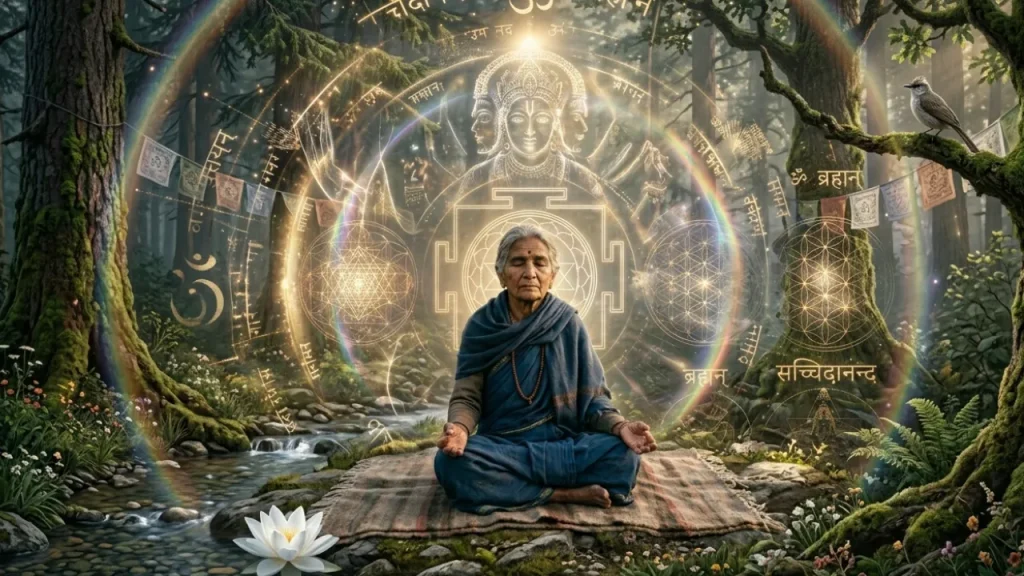
Therefore, Brahman is that absolute, unchanging non-dual reality, out of which its supreme ability is that of Para (beyond) Brahman, indicating the supreme Brahman is the ultimate source and cause of all existence beyond all attributes and descriptions, the transcendent before any manifestation and conceptualisation, we refer to as beyond any human god, equivalent to Prajnanam Brahma, settled in the human mind as That Art Thou.
All differences vanish in this awareness; no seeker, search, or enlightenment exists. The undivided, always present in unity and continuity, is Brahman. The Sanskrit meaning to expand and grow is you, me, and everything, yet beyond all definitions, which today quantum physics calls energy, meaning to develop and grow, implying all that exists is energy in the universe, identical to Brahman.
Advaita Vedanta further suggests that Brahman is the highest, non-dual, eternal reality within which temporal subset energies appear and disappear, which science identifies as matter and consciousness. It means the formless Brahman (energy) takes forms yet remains as the substrate, untouched. On the other hand, Para Brahman possesses the veiling power (Maya), creating the illusion of space, time, and form in separation, thereby binding the mind to participate in the dance of existence (Lila). It means the formless takes temporary forms in matter and consciousness in a divine play, expressing dualities to experience what life in dual living is all about.
Brahman embodies the perspective of the everlasting, universal Self, playing a false game of dualism, conceiving enlightenment as an inherent state and the Self as an aware, energetic entity. People experience it as a fundamental fact of life, not a goal to pursue. There is no such thing as enlightenment, for you are already the enlightened present in the mind within the individual soul as the universal spirit.
The Upanishads state, “Tat Tvam Asi,” or “That art Thou,” indicating that the personal self, or Atman (soul), embodies the universal Self as the aware energy, enabling the mind to become aware and conscious and perceive through its sensory organs. Both the dual in separation and the non-dual are not apart from Brahman, for you are that creator, and the creation plays the dance of existence in relative dualities. There is no outside God; you are that divine to experience the duality of divine or the devil through your say, divine deeds in divinity for the sake of that divineness.
The difference between Brahman and God is that the former represents formless, supreme energy, and the latter refers to a human being with a higher level of consciousness. ‘Thou Art That’ refers to the subject of formlessness nearest to being ‘Aham Brahmasmi’ as that Supreme energy you already are. However, one continues to seek enlightenment from the objective self of body and mind, which you are not. You are that divine spirit going through human experiences of body and mind, which you call yours.
Hence, Brahman is the aware energy that brings life to every living creature. There is none other than Brahman; you genuinely require awakening to know ‘who you are’ rather than being confused and concerned about remaining ‘what you are’ in body and mind, which you always claim as yours. It is the identity others give you to experience life while you are alive.
Brahman is that infinite, absolute energy from which everything appears and disappears, in which everything is sustained and retained. It is the only existent in the Universe from which every attribute, including your body and mind, emerges, expands, effectuates, and evolves to return to the same.
Vedanta discusses the knowledge of the Self, which is already present. The presence of that being-ness in waves of aware energy makes your mind and body aware and conscious, allowing you to experience and realise what life in the relativities of duality is all about.
The human mind constantly seeks something and tries to experience meditation, yoga, Zen, and other practices, such as applied psychology, to discipline the mind. Such realisations take one only toward the periphery of one’s inner Self. The centre, being that spirit, always remains enlightened and realised, needing no further realisation from the mind. It simply watches the cognitive mind in all its experiencing and realising.
Para Brahman is the spirit – the witness in the mind; the Brahman is the pure individual non-dual consciousness, Sakshi, or the Witness-er, which knows but is yet to discover itself. You, as the universal aware Self, are required to witness the cognitive mind through the individualised soul, representing the witness-er unquestioningly and without any judgements playing the game of dualities in this and that, here and there, for the likes and dislikes of the mind selfishly, which we call The Dance of Nataraja.
The above-mentioned is not difficult to know but complex to apprehend. You are Ishvara (God), the cause of this entire universe, since it is because of ‘you’ through your mind that the cosmos exists. Hence, the mind cannot experience this eternal knowledge unless it is understood. Knowledge is about acquiring facts and information; understanding requires intelligence to apply that knowledge righteously.
Understanding is the foremost and predominant factor, which, besides intellect, requires a certain degree of intelligence. Through understanding, one comes to realise that one is ‘Isvara’ himself, which requires only awakening from the soul to spontaneously activate the mind and experience the life of dualities in a balanced manner, righteously.
In every situation, the mind and body play a relative role, such as that of a father, son, friend, master, husband, etc., all in one composite form. He forgets who he truly is, remaining anxious, insecure, and confused. Besides the physical and the psychic personality of what you are quantitatively, the mind must know its master, the spirit embedded in the soul, to understand qualitatively the unique individuality of who you are. One who knows Brahma-Gyan secures Brahman; you effortlessly awaken, evolve, and transform with this ultimate understanding.
NAMASTE
Leave a Reply